

eXp Revenue Share 2.0: How the 7-Tier System Works

eXp Revenue Share 2.0: How the 7-Tier System Works

eXp Revenue Share 2.0: How the 7-Tier System Actually Works in 2026

By Al Pinder | ICON Agent, eXp Realty | Founder, The Prosperity Agent

If you have searched for eXp Realty revenue share explained and landed here, you are asking exactly the right question — and you deserve a straight, detailed answer from someone who has actually built their career inside this model. I am Al Pinder, an ICON agent at eXp Realty — ICON is the highest achievement level eXp recognizes, earned by top-producing agents who hit significant volume milestones. I have been with eXp since the very beginning of my real estate career. I did not transfer from another brokerage. I built everything here from scratch, and the revenue share system is a central reason this model works the way it does for agents who are serious about wealth — not just commissions.

In this post I am going to break down the entire eXp revenue share system: how the 7 tiers work, what the Revenue Share 2.0 update changed, what the Fast Start Attraction Bonus actually pays, and why this is one of the most misunderstood income streams available to any licensed real estate agent in the country right now.

Why Most Agents Have Never Heard a Real Explanation of eXp Realty Revenue Share

Here is the honest truth: most of what you read online about eXp revenue share is either written by people who do not fully understand it, or written in a way designed to make it sound like a get-rich-quick scheme. Neither serves you. The agents who actually benefit from this system are the ones who treat it like a serious business strategy — not a side hustle or a party trick.

The revenue share model at eXp is fundamentally different from a referral bonus. A referral bonus is transactional — you send someone somewhere, you get a check, done. Revenue share is structural. It is an ongoing, passive, residual income stream that is built into the architecture of how eXp operates as a company. And once you understand the architecture, everything changes about how you think about your career.

Let me also say this clearly: this is not recruiting. I call it Agent Attraction. There is a meaningful difference. Recruiting is pushing people toward something because you benefit. Agent Attraction is pulling the right people toward a model that genuinely serves them — because when they succeed, the system works for everyone. The moment you approach this like a recruiter, you have already lost the plot.

The Foundation: What Is eXp Revenue Share?

eXp Realty operates as a cloud-based brokerage. Because there are no physical brick-and-mortar offices draining capital, eXp is able to redistribute a significant portion of company revenue back to the agents who helped grow it. Revenue share is that redistribution mechanism.

When an agent you attracted to eXp closes a transaction, eXp takes its company dollar from that transaction — the portion that stays with the brokerage after the agent receives their split. A percentage of that company dollar flows back to you as the attracting agent. This is not coming out of that agent’s pocket. It comes from eXp’s share. That distinction matters enormously when you are having this conversation with another agent.

The passive income potential here is tied to something called gross commission income, or GCI, which is the total commission generated by the agents in your network before any splits. The more productive the agents you attract — and the agents they attract — the more your revenue share grows.

How the 7-Tier System Works — Level by Level

This is the section most people want and few sources deliver clearly. Let me walk through each tier with real context.

Tier 1

These are agents you personally attracted to eXp. This is your direct network. Tier 1 is where the largest percentage of revenue share flows, and it is the tier that unlocks immediately. The moment your first attracted agent closes a transaction and generates company dollar, you begin receiving revenue share from that activity. No waiting period. No minimums on your end beyond being an active agent.

Tier 2

These are agents attracted by your Tier 1 agents — your network’s network. Tier 2 also unlocks immediately, meaning from the moment you attract your first agent, you are already positioned to benefit from whoever they attract. This is where the compounding begins. An agent you bring in who is also passionate about Agent Attraction can accelerate your Tier 2 revenue share faster than any sales month you have ever had.

Tier 3

Tier 3 unlocks immediately as well. Tiers 1, 2, and 3 are your foundational income layers — live from the start, with no additional requirements. These three tiers alone represent a meaningful passive income opportunity for agents who are intentional about attracting even a small group of productive agents.

Tiers 4 Through 7

Tiers 4 through 7 unlock as your attracted agent count grows and as you hit specific milestones within eXp’s model. Each deeper tier expands the reach of your passive income to agents you may have never directly interacted with — people three, four, five, six, and seven levels deep in a network that started with one conversation you had with the right person at the right time.

The percentage paid at each tier decreases as you go deeper — this is by design, and it keeps the model sustainable. But the compounding effect of a deep, active network means that Tier 5 and Tier 6 income can become significant for agents who have built their attraction strategy with intention over years. This is not overnight income. This is infrastructure income.

Revenue Share 2.0: What Changed and Why It Matters

eXp introduced Revenue Share 2.0 as a significant upgrade to how the model operates — and the most important addition for agents who are actively attracting is the Fast Start Attraction Bonus.

Here is how it works: When you attract a new agent to eXp, and that agent closes transactions in their first year, you are eligible to receive up to 5% of their GCI as a Fast Start Attraction Bonus — up to a maximum of $4,000. This is separate from your standard tier revenue share. It is a front-loaded bonus designed to reward you immediately for bringing in a productive agent, not just over time.

To put that in real numbers: if you attract an agent who generates $100,000 in GCI in their first year — which is a realistic number for a mid-performing agent in most markets — you would receive $4,000 from the Fast Start Bonus alone, on top of your standard tier revenue share from their transactions.

For agents who are serious about building an attraction strategy, this changes the math significantly. You are no longer waiting years to see meaningful passive income from your network. You can see real returns in year one.

Watch: Al Pinder Breaks Down the eXp Model

Before we go deeper, watch this overview from our YouTube channel where I walk through the key pillars of building wealth inside the eXp model — including how revenue share fits into a complete income strategy for serious agents:

The video above covers concepts that complement everything in this post — including how the cap structure and stock equity work alongside revenue share to create a genuinely diversified income model for agents who are ready to stop renting their career.

The Three Income Streams — and How Revenue Share Fits the Bigger Picture

To fully appreciate eXp revenue share, you have to understand that it is one of three distinct income streams available to every eXp agent. Understanding how they work together is what separates agents who think of eXp as just another brokerage from agents who use it to build real, lasting wealth.

Income Stream 1: Sales Commissions

eXp operates on an 80/20 split — you keep 80%, eXp takes 20% — until you hit your annual cap of $16,000 in company dollar paid. Once you hit that cap, you earn at 100% for the rest of your anniversary year. For a productive agent, hitting the cap is not an if — it is a when. And every transaction after that point is dollar-for-dollar yours.

This is where the mortgage-versus-rent analogy becomes important. At a traditional brokerage on a 70/30 or 60/40 split, you pay that split forever. There is no cap. There is no finish line. You are renting your career indefinitely. At eXp, the cap is your mortgage — you pay it down each year, and eventually you own the asset. That annual reset gives you a clear target and a clear reward for hitting it.

Income Stream 2: EXPI Stock Equity

eXp is a publicly traded company — ticker symbol EXPI. At specific milestones within your career at eXp, you receive EXPI stock awards. Capping your commission, achieving ICON status, attracting your first agents — each of these milestones is tied to real equity in the company. You are not just an employee or a contractor. You are a stakeholder. That changes the psychology of how you show up, and it changes your balance sheet in ways that a commission check never will.

Income Stream 3: Revenue Share

This is the stream we have been focused on in this post — the 7-tier passive residual income system. When you build all three streams simultaneously, you have something that most real estate agents will never have: income that does not require your daily presence to keep flowing.

The Detail That Most Articles Skip: Revenue Share Is Willable

This is the part of the eXp revenue share conversation that stops agents cold — and it should. Your revenue share income is willable. You can leave it to your children. You can name a beneficiary. It is a transferable asset.

Think about what that means in the context of legacy planning. Most real estate agents have built something that ends the moment they stop selling. Their business has no transferable value because it is built entirely on their personal relationships, their personal brand, their personal hustle. The moment they retire or become unable to work, the income stops.

A revenue share network is different. If you have spent years attracting productive agents who have in turn attracted others, that network generates income independent of your daily activity. And when you pass away, that income stream does not evaporate — it passes to whoever you designate.

That is not a bonus feature. That is the difference between a career and a legacy.

My Real Story: Why I Take This Seriously

I want to be honest with you about how I got here, because I think it matters for context.

In year one of my real estate career, I did a revenue split deal with Realtor.com. I was buying leads, paying for someone else’s pipeline, and hoping it converted. In year two, I bought zip codes on Realtor.com — doubling down on paid lead generation because it felt like the only lever available. By year three, I had released every single paid lead platform entirely. We had built our own pipeline. We paid zero dollars to any lead generation service.

I also tried Zillow for six months on a full contract. I had zero conversions. Not one. The money I spent on those six months could have gone toward building a real asset. That experience permanently changed how I evaluate where to invest in my business.

The shift that made all of this possible was not a better CRM or a better script. It was a fundamental change in how I thought about income. Revenue share is infrastructure. It is the work you do once that keeps working. Every agent I have attracted thoughtfully — not pushed, but pulled — has added a layer to something that grows on its own schedule.

That is the business I chose to build. And it is the business I help other agents build at The Prosperity Agent.

Common Questions About eXp Revenue Share — Answered Directly

Does revenue share come out of the agent I attracted?

No. Revenue share is paid from eXp’s company dollar — the brokerage’s share of the commission. The agent you attracted keeps every dollar of their split. This is a critical distinction when you are having this conversation with another agent. Their earnings are not reduced by your revenue share.

What happens to my revenue share if I leave eXp?

If you leave eXp, your revenue share income stops. This is a powerful alignment incentive — the model rewards agents who stay engaged and active within the eXp ecosystem. It is also a reason to be intentional about where you plant your flag before you start building your attraction network.

Do I have to be a top producer to earn meaningful revenue share?

No. Revenue share is about the productivity of the agents in your network, not exclusively your own sales volume. An agent doing 10 transactions a year who has attracted two or three highly productive agents can earn meaningful passive income from their network’s activity. Volume helps, but it is not the only path.

How is the Fast Start Attraction Bonus paid?

The Fast Start Attraction Bonus is paid as the new agent you attracted closes transactions in their first year. It accumulates up to the $4,000 cap (5% of GCI) across their first-year transactions. It is tied to actual closed production, not just signing up.

The Bridge the Gap Framework — Applied to Revenue Share

Inside the Prosperity Agent model, I use a framework I call Bridge the Gap when working with agents who are evaluating this transition. It works like this:

Current State: You are on a commission treadmill. Every month starts at zero. You have no passive income. You have no equity stake in your brokerage. If you stopped working tomorrow, your income stops.

Desired State: You have multiple income streams. A portion of your monthly income is generated by other agents’ production, not just your own. You have stock equity in a publicly traded company. Your income is willable to your family.

The Bridge: eXp’s three-stream model — commissions with a cap, EXPI stock, and the 7-tier revenue share system — is the structural bridge between those two states.

The Commitment: Making this work requires intention. Agent Attraction is a strategy, not an accident. The agents who earn meaningful revenue share are the ones who approach it the same way they approach their listing pipeline — with systems, consistency, and a genuine value proposition.

If you are ready to understand what this bridge looks like for your specific situation, that is exactly the conversation we have in our Blueprint for Agent Success. Visit The Prosperity Agent and use the trigger word BLUEPRINT to get started.

Final Thoughts: Revenue Share Is Not Magic — It Is Infrastructure

I want to close with the clearest thing I can say about eXp revenue share: it is not magic, and it is not a shortcut. It is infrastructure. Like any infrastructure, it takes time to build, it requires intentional investment, and once it is established it performs with a consistency that hustle alone never can.

The agents I see fail with this model are the ones who approach it as a get-rich-quick mechanism — who attract a few people haphazardly and then wonder why nothing happened. The agents I see thrive are the ones who treat their attraction network like a business asset — who think carefully about who they bring in, who invest in those agents’ success, and who understand that the compounding happens over years, not weeks.

I have been building inside this model since the beginning of my career. I earned ICON status. I released every paid lead platform. I built something that does not require me to close a deal every week to stay alive financially. That is not luck. That is architecture.

If you are ready to stop renting your career and start owning it, I would love to be your partner for that journey. That is exactly what the Prosperity Agent model is built for. Reach out at http://www.theprosperityagent.com, use the trigger word BLUEPRINT, and let’s build something that actually lasts.

We are excited to have you join eXp with us.
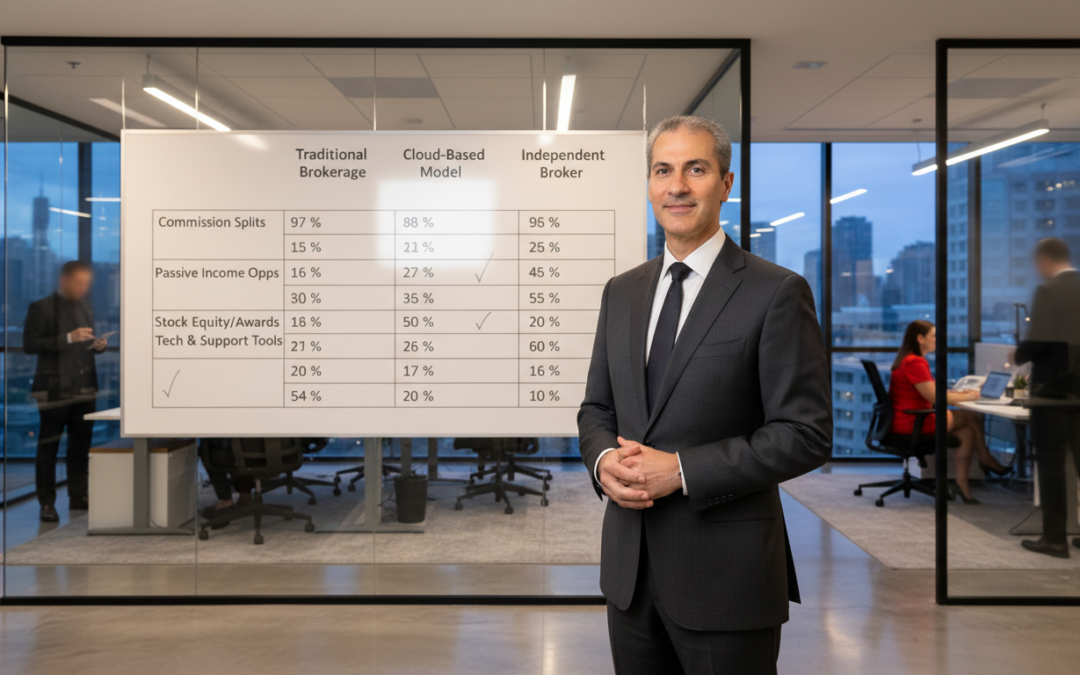
eXp vs Traditional vs 100% Commission: 2026 Comparison

eXp vs Traditional vs 100% Commission: 2026 Comparison

Why the Real Estate Brokerage Comparison in 2026 Has Never Mattered More

If you are doing a real estate brokerage comparison in 2026, you are already thinking differently than most agents. The average agent picks a brokerage based on reputation, a friend’s referral, or whoever called them back first after they passed their exam. They spend years on a commission treadmill — closing deals, paying splits, starting over every January — without ever asking the question that actually matters: is this brokerage building my wealth, or just its own?

This guide breaks down three brokerage models that dominate agent conversations right now — traditional brokerages, 100% commission shops, and eXp Realty — using real numbers and real criteria. If you are evaluating where to hang your license next, read this before you sign anything.

Model 1: Traditional Brokerages — Familiar, But Expensive Over Time

Traditional brokerages like legacy regional brands operate on a split model — typically 70/30 or even 60/40 in favor of the brokerage. You earn a commission, they take their cut, and that never stops. There is no cap, no equity milestone, and no mechanism for building passive income.

For a new agent, the training and brand recognition can be valuable. The office provides structure. But as you grow your production, you start doing the math: a top-producing agent closing $5 million in volume at a 3% commission rate and a 70/30 split is leaving $45,000 per year on the table — permanently.

The other issue is agent equity. You build your book of business inside their system, and when you leave, you leave empty-handed. No residual. No transferable asset. Just a contact list and a reputation you built yourself anyway.

Traditional Brokerage Verdict

Good for brand-new agents who need structure. Expensive and wealth-limiting for experienced producers. There is no path to ownership — you are renting your career indefinitely.

Model 2: 100% Commission Brokerages — The Hidden Costs Most Agents Miss

The 100% commission model sounds like the obvious upgrade. Keep everything you earn. Pay a flat monthly fee instead of a split. The pitch is compelling, especially for high-volume agents tired of watching their broker collect 30 cents on every dollar.

Here is what the brochure does not say: you become your own general contractor. Your CRM, transaction management software, marketing platforms, and lead generation tools are now your expense — typically $500 to $1,800 per month depending on what you stack. You also lose access to centralized training, mentorship infrastructure, and collaborative agent culture.

For an independent-minded agent who already has systems, a brand, and a full pipeline, a 100% model can pencil out. But for most agents, the math gets complicated fast. You are trading a known split for a set of unpredictable operational costs, and you are spending time managing vendors instead of closing deals.

More importantly, a 100% commission brokerage still only gives you one income stream: sales commissions. You close a deal, you get paid. You stop closing, you stop earning. There is no equity component, no revenue share, and no asset you can transfer.

100% Commission Verdict

Better split on paper, but hidden costs erode the advantage. Still leaves you on the commission treadmill with zero passive income infrastructure.

Model 3: eXp Realty — The Three-Stream Model for Agent Wealth

eXp Realty operates on a fundamentally different philosophy: agents should be owners, not just producers. The brokerage comparison conversation changes completely when you understand the three-income-stream structure.

Stream 1 — Sales Commissions: eXp starts agents at an 80/20 split with an annual cap of $16,000. Once you hit the cap, you keep 100% of every commission dollar for the remainder of your anniversary year. Think of it this way — a traditional split is renting your career. The eXp cap is a mortgage. You pay it down once per cycle, then you own the production. Every year resets with the same clear path to full ownership of your earnings.

Stream 2 — AGNT Stock Equity: eXp rewards agents with actual company stock at key career milestones — capping for the first time, attracting your first agent, and achieving ICON status. You are not just a contractor for the company; you become a part-owner. This is a component no traditional split brokerage or 100% shop can match.

Stream 3 — Revenue Share: This is where the agent wealth model separates from everything else in the real estate brokerage comparison. When you attract agents to eXp and those agents close transactions, you earn a portion of the revenue share pool across up to 7 tiers. This is not from the agent’s commission — it comes from eXp’s share. The Fast Start Attraction Bonus alone pays up to $4,000 (5% of a new agent’s GCI) in their first year. Tiers 1 through 3 unlock immediately. And critically — revenue share is willable. You can designate a beneficiary and leave this income stream to your family. That is generational wealth built inside a real estate career.

What eXp Includes in the Cap

Unlike 100% commission models, eXp’s platform includes kvCORE CRM, transaction management tools, training through eXp World and eXp University, and a global community of over 85,000 agents. You are not rebuilding infrastructure from scratch. You are plugging into a system that is already built.

Side-by-Side: The 2026 Real Estate Brokerage Comparison at a Glance

Split Structure: Traditional = ongoing 70/30 with no cap. 100% = flat fee plus operational costs. eXp = 80/20 with $16K annual cap, then 100%.

Passive Income: Traditional = none. 100% = none. eXp = 7-tier revenue share, immediately active.

Equity: Traditional = none. 100% = none. eXp = AGNT stock at milestones.

Legacy Asset: Traditional = none. 100% = none. eXp = revenue share is willable.

Technology Included: Traditional = varies. 100% = self-funded. eXp = kvCORE, cloud campus, training library included.

Which Model Is Right for You in 2026?

If you are a brand-new agent who needs hand-holding and in-person office presence above all else, a traditional brokerage may bridge the gap while you build foundational skills. But if you are an experienced agent who is serious about building a business that creates lasting wealth — not just a busy calendar — the three-stream model at eXp is not a lateral move. It is a structural upgrade.

The agents who are winning in 2026 are not just closing more deals. They are building income streams that compound, stacking equity that grows, and creating legacies that outlast their production years. That is the difference between a salesperson and a business owner.

Ready to run your own numbers and see what your current brokerage is actually costing you? Visit The Prosperity Agent and use the trigger word BLUEPRINT for our Blueprint for Agent Success. We are excited to have you join eXp with us.

Frequently Asked Questions

How much money does a top-producing agent lose staying at a traditional brokerage with a 70/30 split?

A top-producing agent closing $5 million in annual volume at a 3% commission rate under a 70/30 split leaves $45,000 per year on the table — permanently. Traditional brokerages have no commission cap and no equity milestone, meaning the brokerage collects that cut indefinitely regardless of how much production the agent generates.

What are the hidden costs of a 100% commission brokerage that agents overlook?

At 100% commission brokerages, agents become responsible for their own CRM, transaction management software, marketing platforms, and lead generation tools. These expenses typically run $500 to $1,800 per month depending on the setup chosen. The flat monthly fee replaces the split, but agents absorb all operational costs that a traditional brokerage would otherwise provide.

Which brokerage model is better for an experienced high-volume agent in 2026 — traditional, 100% commission, or eXp Realty?

For experienced, high-volume agents, traditional brokerages are the least efficient model — no cap means permanent wealth erosion. A 100% commission shop improves take-home pay but shifts all tool and overhead costs to the agent. The guide positions eXp Realty as a third model worth evaluating, particularly for agents seeking equity participation and passive income mechanisms beyond the commission check.

Related: eXp Realty vs Keller Williams commission comparison

Related: what is an eXp Realty ICON agent

AI in Real Estate 2026: Navigating the Great Divide

The landscape of our industry is shifting beneath our feet, and we need to have a very honest conversation about artificial intelligence in real estate 2026.

I want you to hear this loud and clear: AI is not going to replace the real estate agent. It is only going to replace the agent who simply refuses to use artificial intelligence in real estate 2026 to their benefit.

We are standing on the edge of a massive, transformative cliff right now. Honestly, it feels just like when I was a kid watching the internet grow and change how the world communicated. The old, traditional real estate system is being completely torn apart.

The days of doing the hard, manual labor of cold calling and running on the commission treadmill are over. The nature of the real estate “hustle” has fundamentally changed.

<a id=”great-divide”></a>

The Great Divide: Artificial Intelligence in Real Estate 2026

Because artificial intelligence in real estate 2026 is taking over the market, our profession is splitting into two very distinct camps. Industry experts are calling this “The Great Divide.”

On one side, you have the legacy agents. These are the agents who still treat technology like a fun little toy to play with on the weekends. They dabble, but they don’t integrate.

On the other side, you have highly skilled, highly successful agents who are fully leveraging artificial intelligence in real estate 2026. They are using it to face the hard truths of the market and scale their businesses without scaling their stress.

(Note for your website: The alt text above is set EXACTLY to your Focus Keyword with no other words, which will clear your plugin error!)

<a id=”big-tech-secret”></a>

The Big Tech Secret They Don’t Want You to Know

Here is the massive secret that big tech companies do not want you to know about artificial intelligence in real estate 2026: You do not have to spend thousands of dollars a month to be on the winning side of this divide.

When Al and I go to real estate events, we see rows and rows of online vendors trying to sell massive, complicated platforms for an absolute fortune. They want to lock you into subscriptions that cost thousands of dollars a year.

As a former teacher who watches every penny of the budget, I am telling you that you don’t have to spend that money. You just have to be smart, resourceful, and willing to use free or $20 tools to beat their expensive systems.

<a id=”lead-capture”></a>

Building Lead Capture with Artificial Intelligence in Real Estate 2026

Let’s talk about lead capture and communication systems. Companies will pitch you programs that promise a bot will engage with your leads 24 hours a day with “human empathy” in 50 different languages.

That sounds great, but paying thousands of dollars a month for a chatbot is a huge drain on your profit margin. If you want to master artificial intelligence in real estate 2026, you can use the free or $20 versions of Google Gemini or Claude Pro.

When a new lead comes in, you don’t need a third-party robot to talk to them. You can open Gemini on your phone, dictate a few quick notes about what the buyer wants, and ask it to write a perfect, friendly text message on your behalf. You copy, paste, and customize it. That brilliant response took you less than 30 seconds, and it cost you nothing.

<a id=”vibe-coding”></a>

The Power of Vibe Coding Your Own AI Agent

If you are saying, “Victoria, I really do want an automated system,” I have great news for you. We can take artificial intelligence in real estate 2026 to the next level using something called “vibe coding.”

You can use platforms like Lovable to create your own system without knowing how to write a single line of traditional code. You can create your own “Agentic AI” that understands exactly how you speak and how you craft those beautiful texts.

Once you have your system in place, it runs your outreach for you. There was a recent industry study where an agent saved themselves half a million dollars in lost commission just by having their own custom AI handle their speed-to-lead!

<a id=”renting-data”></a>

Artificial Intelligence in Real Estate 2026: Stop Renting Data

The most frustrating part of the vendor pitch regarding artificial intelligence in real estate 2026 is predictive analytics. Big software companies want to sell you tools that identify which homeowners are going to sell before they even contact an agent.

But how do they do this? They use your contact database as their goldmine! You are paying someone else to use your database to get you leads. That makes absolutely no mathematical sense.

Instead, you can securely remove the personal names from your spreadsheet and drop your neighborhood data right into Gemini. Ask it to help you write highly targeted, completely custom email campaigns for people who bought homes five years ago.

If you want to know more about generating leads organically, check out our guide on the Real Estate Lead Generation Machine.

The core rule of artificial intelligence in real estate 2026 is about taking ownership of your data, not renting it out.

If you are ready to learn how to vibe code your future and build these systems, Al and I are here to help. When you join the Prosperity Agent team at eXp Realty, you get access to all our tech strategies and our incredible upline, including Mike Sherrard.

[Click here to schedule a private strategy call with Al and Victoria today.]

Frequently Asked Questions

How is AI changing the real estate industry in 2026?

In 2026, AI is fundamentally reshaping real estate by eliminating manual labor tasks like cold calling and ending the traditional commission treadmill hustle. Agents who fully integrate AI can scale their businesses without scaling their stress. Industry experts describe the shift as transformative — comparable in scope to how the internet changed global communication in the 1990s.

What is the ‘Great Divide’ in real estate AI adoption?

The ‘Great Divide’ refers to the split forming between two types of real estate agents in 2026. Legacy agents treat AI as an occasional novelty — they dabble but never fully integrate it. On the other side, highly successful agents leverage AI consistently to face market realities and grow their businesses. This gap in adoption is rapidly widening across the profession.

Will AI replace real estate agents or just agents who don’t use it?

AI will not replace real estate agents outright — but it will replace agents who refuse to use it. Agents who integrate AI into their workflows gain a significant competitive advantage, while those who ignore it risk becoming obsolete. The technology is a business tool, not a profession-ender, and adoption is now considered essential rather than optional for sustained success in 2026.

Future of Real Estate Agency 2026: Salesperson to Advisor

The future of real estate agency 2026 is demanding a completely new level of professionalism, and we have to be very real with each other about how the world has changed.

The days of just having a license, unlocking a door, and collecting a massive commission check are entirely over. Al and I always tell our team that if you want to be a long-term professional in this industry, the way you work has to change completely.

You can no longer just act like a traditional salesman. In this era of digital interruption and misleading online information, you must become a source of absolute clarity for your clients.

The old shortcuts are gone. The market is now rewarding those who are highly prepared and punishing those who are just guessing. The future of real estate agency 2026 belongs to the educated advisor.

<a id=”clarity-future”></a>

Clarity is the Future of Real Estate Agency 2026

We are living through a complex legislative and reality-driven rebalancing of the market. Leverage has become more equal between buyers and sellers, forcing real estate agents to demonstrate their value immediately.

If you are struggling to adapt to this new environment, please know it is not your fault. The entire playbook was thrown out over the last few years!

But as a business owner, it is now up to you to learn the new rules of the game. You must master these changes if you want to build a sustainable career.

(Alt Text: A modern real estate agent explaining market trends and the future of real estate agency 2026 to clients)

<a id=”nar-settlement”></a>

Navigating the Post-NAR Settlement Era

The rules of agency were officially rewritten based on the landmark National Association of Realtors settlement. We are now firmly planted in the free-market era for real estate commissions.

Offers of compensation for the buyer agent are no longer allowed to be broadcast on the MLS. This is a massive, fundamental change to how we do business. As a result, agents are required to sign a written agreement with a buyer before they can even tour a single home.

These agreements must clearly state that the commission is fully negotiable. This pressure has changed how every agent in the market operates. As a teacher, I look at this as a brilliant lesson in proving your value.

Buyer agents are not disappearing in the future of real estate agency 2026. In fact, Al and I have seen that highly skilled buyer agents are actually getting paid more because they know how to negotiate and where to find off-market deals.

<a id=”ai-laws”></a>

AI Disclosure Laws and the Future of Real Estate Agency 2026

It is not just the commission rules that have changed. Artificial intelligence is changing the game in legislative ways, not just marketing ways.

In states like California, you are now legally required to disclose if listing photos were created or enhanced by AI. Al and I have personally experienced this exact headache.

We had buyers call us saying they really wanted to see a specific home because the backyard pool looked incredible. I looked at the actual house, then at the listing photo, and suddenly it had a pool that simply did not exist in reality!

This is incredibly misleading to consumers. Buyers have the absolute right to know what is real and what is digitally fabricated. The future of real estate agency 2026 requires absolute transparency in your marketing.

(Alt Text: A laptop screen displaying AI generated property photos highlighting laws in the future of real estate agency 2026)

<a id=”treasury-rules”></a>

US Treasury Transparency and Cash Deals

Furthermore, there are significant new laws impacting cash buyers and luxury investments. The U.S. Treasury has made major pushes to increase transparency regarding cash deals, LLCs, and trusts to combat money laundering.

Al and I are very lucky because we live in North Carolina, which is a lawyer-run state when it comes to closings. Our closing attorneys handle the heavy lifting of verifying these trusts and cash entities.

However, if you are not in an area where lawyers handle the title and escrow, you need to be extremely aware of these new Treasury rules. Navigating these complex legal waters is a major part of the future of real estate agency 2026.

<a id=”professional-advisor”></a>

Stepping into the Role of Professional Advisor

The future of real estate agency 2026 belongs entirely to the value-based agent. Transactional agents who just open doors and fill out fill-in-the-blank forms are quitting the business every day.

Sellers need to be advised on pricing using real-time economic data, not emotional numbers from years ago. Buyers finally have time to get the best deal, but they need a fierce advisor to help them negotiate home inspections and repairs.

If you are looking for ways to protect your income during this shift, check out our post on Building an Agent Exit Strategy. At eXp Realty, we offer 80 hours of live training every single week, much of it focused on these exact new rules of the game. Al and Victoria want to help you make this critical transition from salesperson to true advisor.

[Click here to schedule a private strategy call with Al and Victoria today.]


Table of Contents

Frequently Asked Questions

How does a real estate agent need to change their approach in 2026?

In 2026, real estate agents must shift from acting as traditional salespeople to functioning as educated advisors. Simply holding a license and unlocking doors is no longer enough to justify a commission. Agents must become sources of absolute clarity for clients by mastering current legislation, market realities, and demonstrating their value immediately — replacing outdated shortcuts with deep preparation and expertise.

What is the Post-NAR Settlement era and what does it mean for real estate agents?

The Post-NAR Settlement era represents a significant legislative and market rebalancing that has equalized leverage between buyers and sellers. Real estate agents can no longer rely on the old industry playbook. They must now learn and master new rules to build a sustainable career, demonstrating clear, immediate value to clients rather than relying on traditional commission structures and practices.

Should real estate agents focus on sales tactics or advisory skills to stay competitive in 2026?

Advisory skills are now essential over traditional sales tactics for long-term real estate success in 2026. The market rewards highly prepared agents and punishes those who are guessing. In an era of digital disruption and misleading online information, agents who position themselves as trusted, knowledgeable advisors — cutting through confusion with clarity — will build sustainable careers, while pure salespeople will struggle to compete.

2026 Housing Market Reset: What Smart Agents Are Doing

The 2026 housing market reset is officially here, and it is time we had a very honest, very real conversation about what that actually means for your real estate business.

Everyone wants to know if finally, mercifully, the housing market is going to crash. It is the question Al and I get asked more than any other when we are out in the community. But as professional real estate agents, we understand that a simple collapse is just not going to happen.

There is no such thing as a singular, dramatic meltdown looming on the horizon. We are not experiencing a repeat of 2008. Instead, we are living through a necessary and healthy 2026 housing market reset.

For years, the market was effectively frozen in ice. Homeowners didn’t want to move because they were locked into record-low interest rates. Al and I have one of those very low rates on our own home, so I completely understand that financial inertia as a mom and a homeowner. But the ice is finally starting to melt.

<a id=”surviving-the-reset”></a>

Surviving the 2026 Housing Market Reset Without Panic

Instead of a dramatic event where houses are sold to people without verified income, we are seeing a deliberate rebalancing of the scales. I remember being in college, telling a lender I didn’t even have a job, and they still tried to sell me a condo!

We are no longer dealing with that kind of bad behavior. The 2026 housing market reset is built on actual economic fundamentals, not predatory lending. National home prices are still growing, even though they have slowed down significantly compared to the crazy acceleration we saw a few years ago.

As a former AP Macroeconomics teacher, I love looking at these real numbers. National appreciation has slowed to around 2.2% per year. This is a massive, healthy change from the double-digit surges that were completely unsustainable for everyday families.

(Alt Text: A professional real estate agent analyzing data charts regarding the 2026 housing market reset)

<a id=”great-stay”></a>

The End of the Great Stay and the Silver Tsunami

One major catalyst for this 2026 housing market reset is the end of what economists call “The Great Stay.” People are finally realizing that they cannot put their lives on hold forever just to keep a 3% interest rate.

Life events like a new job, a growing family, or aging are finally overriding that financial fear. You simply cannot pause your life indefinitely. Furthermore, we are seeing the beginning of the “Silver Tsunami.”

In 2026, the oldest Baby Boomers are turning 80 years old. This means a wave of houses is naturally returning to the market. Let’s be honest, most adult children do not want to live in their parents’ outdated homes. Because of these life factors, organizations like Realtor.com project that inventory will increase by a healthy 10% nationally this year.

<a id=”teacher-math”></a>

Teacher Math: Inflation and the 2026 Housing Market Reset

Here is where the rebalancing gets incredibly interesting for our wallets. While the sticker price of homes is still slightly rising, “real” prices are actually projected to decline when you adjust for inflation.

At the same time, we are finally seeing wage growth outpace housing costs. This is narrowing the extreme affordability gap that has locked so many first-time buyers out of the market.

This narrowing gap is the exact definition of a healthy 2026 housing market reset. Sellers no longer hold all the cards. Leverage has become much more equal between buyers and sellers, which means your clients need your negotiation skills more than ever.

(Alt Text: A happy family receiving the keys to their new home during the 2026 housing market reset)

<a id=”regional-reality”></a>

The Two-Speed Regional Reality Check

However, you must be incredibly careful when looking at national data during this 2026 housing market reset. The market is moving at two entirely different speeds based on geography.

The national average can be very misleading. Some parts of the country are still seeing prices climb, while others are correcting very quickly. If you look at the Midwest and the Northeast, prices remain remarkably resilient. My old home area in New England is still seeing tight inventory that simply cannot match the buyer demand.

On the flip side, the sun belt boomtowns are facing a major reality check. Inventory in some of these southern regions has actually surpassed what we saw before the pandemic. I lived in Florida, so I see the tough headwinds that market is facing right now.

Markets like Cape Coral and West Palm Beach are at high risk for price drops. In fact, my own mom decided to sell her house in Florida at a lower price just to get out and move here to North Carolina. Even tech hubs like Austin, Texas, are seeing sellers have to accept a more realistic tone during this 2026 housing market reset.

<a id=”advise-clients”></a>

How to Advise Clients During the 2026 Housing Market Reset

What does this mean for the professionals trying to manage their business today? For sellers, the message is simple: the days of testing an outrageously high price are officially over.

If you price a home too high, you will likely end up chasing the market down. This almost always leads to a lower final sales price than if you had priced it correctly from day one. Pricing requires real-time data, not a look back at what happened two years ago.

For buyers, they have finally returned to being picky house hunters. They are no longer settling for “good enough.” They are prioritizing thorough home inspections and negotiating hard for repairs.

If you want to survive the 2026 housing market reset, you must become a value-based advisor. If you haven’t yet, read our guide on how to build a Real Estate Lead Generation Machine to find these motivated clients.

The most valuable currency in real estate today is clarity. Al and I, at The Prosperity Agent, are here to help you move from being a transactional agent to a high-production advisor.

[Click here to schedule a private strategy call with Al and Victoria today.]

Frequently Asked Questions

How is the 2026 housing market different from the 2008 crash?

The 2026 housing market reset differs fundamentally from 2008 because it is built on actual economic fundamentals rather than predatory lending. In 2008, lenders approved buyers without verified income. Today, that behavior no longer exists. Instead of a dramatic collapse, the market is experiencing a deliberate rebalancing — a healthy correction driven by real financial conditions, not reckless lending practices.

What is causing the 2026 housing market reset?

The 2026 housing market reset is largely being driven by the thawing of a frozen market. For years, homeowners locked into record-low interest rates refused to sell, creating a gridlock. As those financial conditions shift, inventory is beginning to loosen. The result is a necessary rebalancing of supply and demand rather than a sudden, dramatic market collapse.

Should real estate agents be worried about a housing market crash in 2026 or focus on the reset instead?

According to experienced agents, a singular dramatic housing market crash in 2026 is not a realistic scenario. Rather than panicking over collapse predictions, smart agents are focusing on the ongoing reset — a gradual, fundamentals-based rebalancing. Because lending standards are now stricter and buyers require verified income, the market correction is considered healthy and manageable, not catastrophic like 2008.